Look at Me
Black South African Women's Liberation in Santu Mofokeng's 'The Black Photo Album'

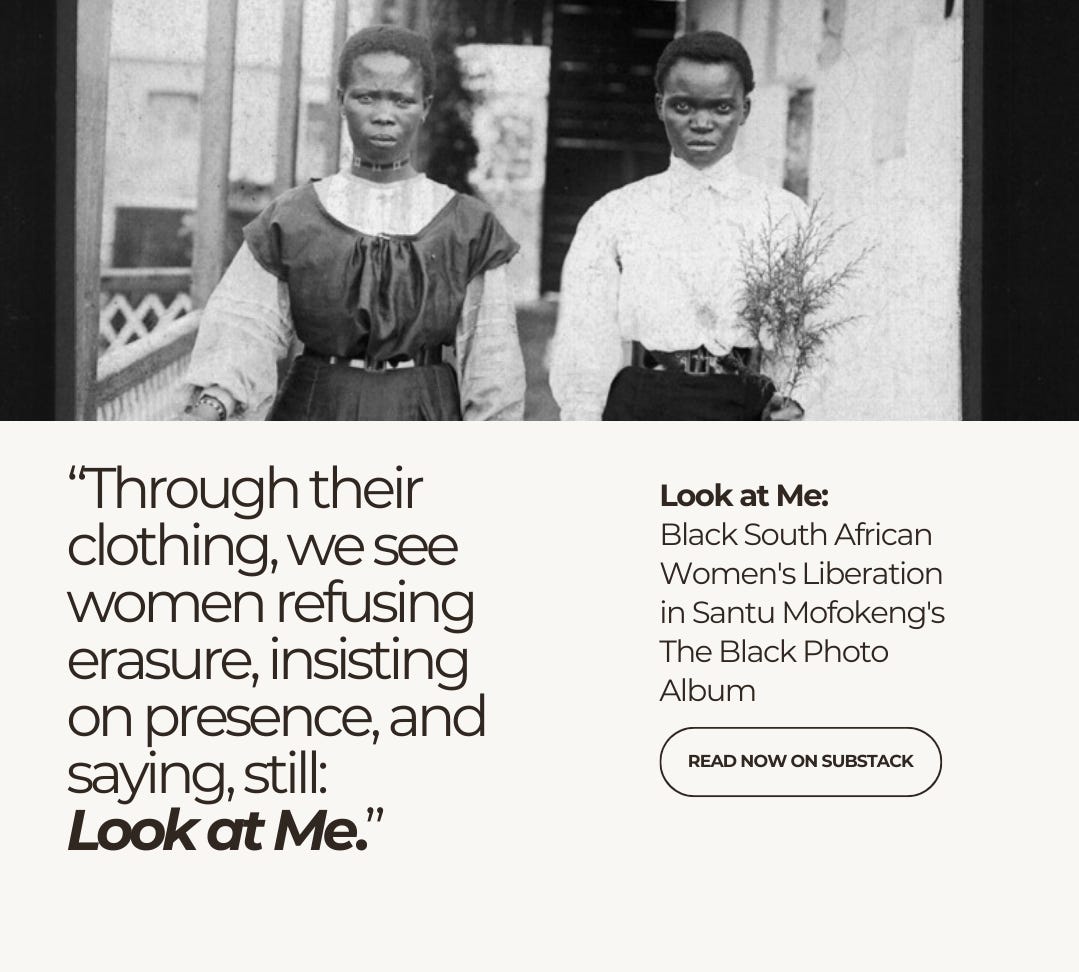
Unknown Photographer, “Unidentified Subjects,” c.1900s. From Santu Mofokeng, The Black Photo Album / Look at Me: 1890-1950 (Göttingen: Steidl, 2013).
Ever since visiting Superfine: Tailoring Black Style in New York, I’ve been inspired to revisit the research I did for both my undergraduate and postgraduate dissertations. At the time, I was studying how photographs can serve as historical evidence (don’t worry, this won’t turn into a dry history lesson). One aspect that drew me in most, then and now, was the clothes: what people chose to wear, and what those choices said about identity, power, and possibility.
As Superfine reminded me: design is never just aesthetic. It is symbolic, imaginative, and political. Clothes are not only functional, they carry meaning. Which is why I want to share one of the most striking archives I encountered during my research: South African photographer Santu Mofokeng’s collection The Black Photo Album / Look at Me: 1890–1950.
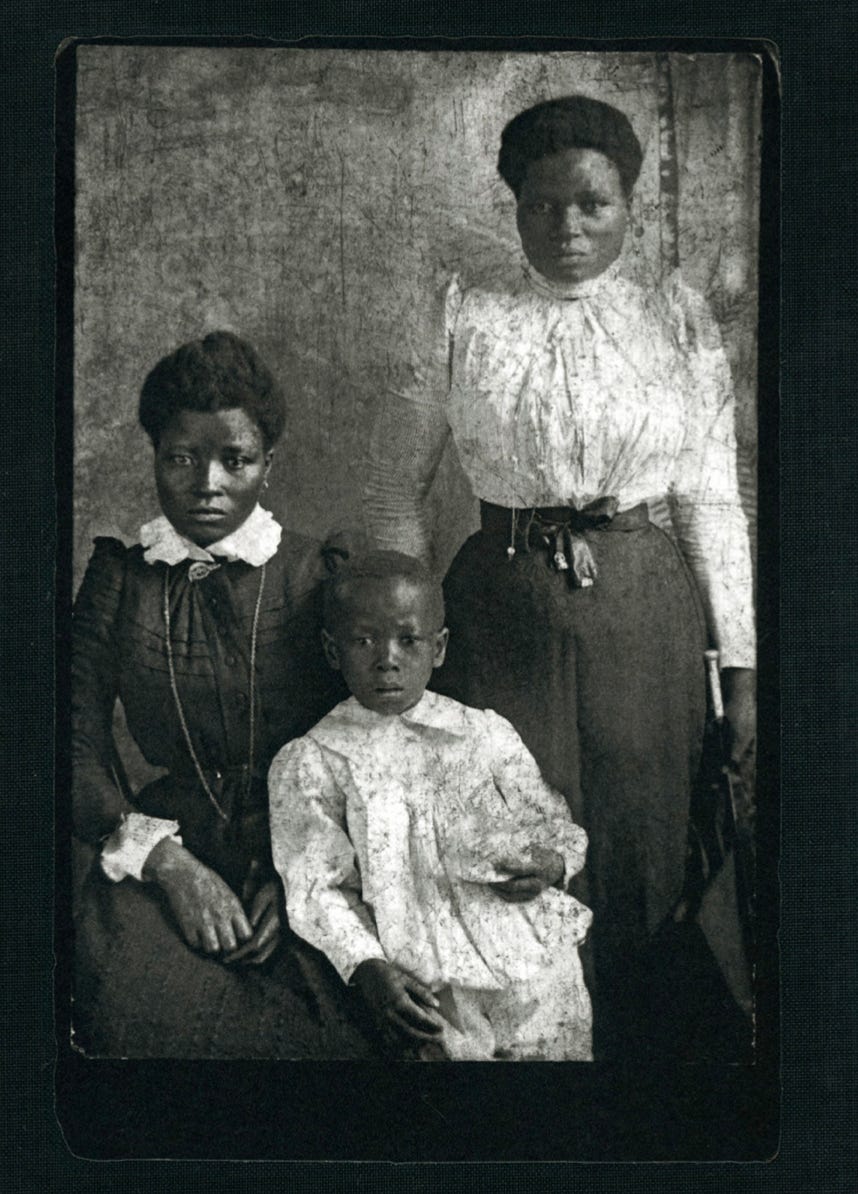
Unknown Photographer, “Unidentified Subjects,” c.1900s. From Santu Mofokeng, The Black Photo Album / Look at Me: 1890-1950 (Göttingen: Steidl, 2013).
The Black Photo Album
In 1995, Mofokeng curated a collection of family photographs taken between 1890 and 1950. The portraits, commissioned by Black families themselves, show men, women, and children dressed in European Victorian styles, stiff collars, dark dresses, parasols, hats, and posed in the rigid fashion of middle-class respectability.
These images were made before Apartheid officially became law in 1948. Still, the political doctrines that would fuel Apartheid were already deeply ingrained in society. These photographs exist in that tension: Black South Africans living under racial hierarchy, but not yet locked into the full brutality of Apartheid’s institutional systems.
Mofokeng’s process of curation means that, in many cases, we know little about the individuals pictured. The images come to us detached from full biographies. And those we do see often represent a small elite, leaving the majority outside this visual record. Yet, despite these limits, the archive captures something profound: how Black South Africans navigated identity under pressure.
Assimilation or Resistance?
Mofokeng framed his exhibition around a difficult question: ‘Do these images represent mental colonisation, or do they challenge Western depictions of “The African?”’
This is a question far beyond the scope of this article. In brief, my own conclusion is that it isn’t one or the other. Human identity, especially in oppressive systems, is hybrid and complex. To me, what’s clear is that these sitters weren’t simply assimilating; they were actively self-fashioning.
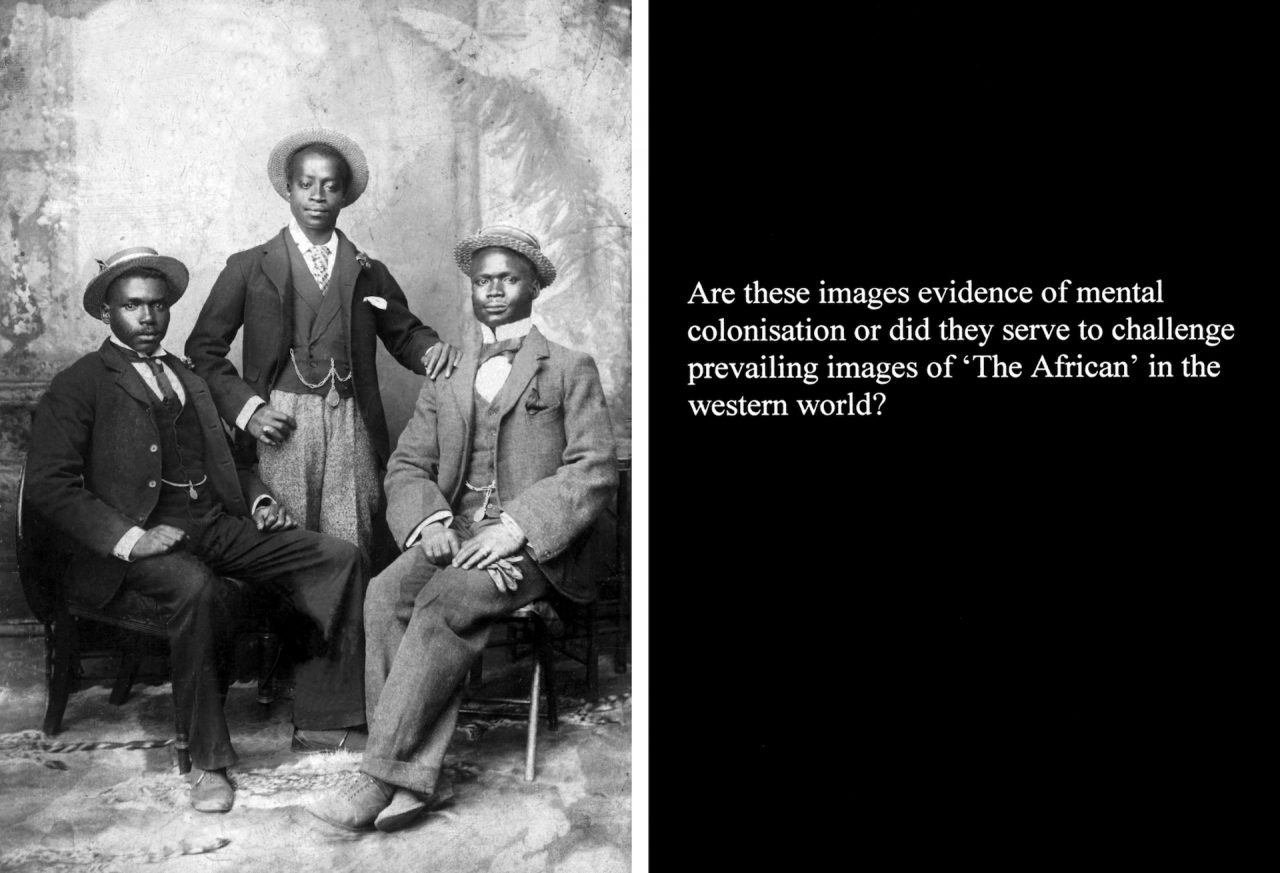
Thos. O’Bryne, Johannesburg, “Subjects Unknown,” 1890. From Santu Mofokeng, The Black Photo Album / Look at Me: 1890-1950 (Göttingen: Steidl, 2013).
Women’s Clothing as an Act of Defiance
Instead of delving into a large-scale discussion, I would like to concentrate specifically on the photographs of four women and discuss how these women used clothing to assume roles outside the limited dichotomy the oppressive South African system offered them. In the photographs of Mmamothupi Motsoatsoe and of Rozetta Dubula with her friends, we see the ways Black South African women used clothing to resist and to reclaim.
Mmamothupi Motsoatsoe is photographed in a dark, formal dress with a stiff collar, clothes often coded as masculine, associated with authority and self-possession. Even the way she holds her parasol mirrors how men carried walking sticks, which were symbols of control during this time. For context, Mofokeng explains that Motsoatsoe’s family was dispossessed by the Natives’ Land Act of 1913. Whilst before she was the daughter of a prosperous farmer, she was now forced to surrender her independence and serve as cheap labour for white people as a domestic servant. According to her daughters, she had a reputation as a ‘proud and cheeky servant, talking back to her employers and dressing like a madam rather than a maid.’ In keeping with this, her portrait is a striking act of reclamation: not servitude, but authority.
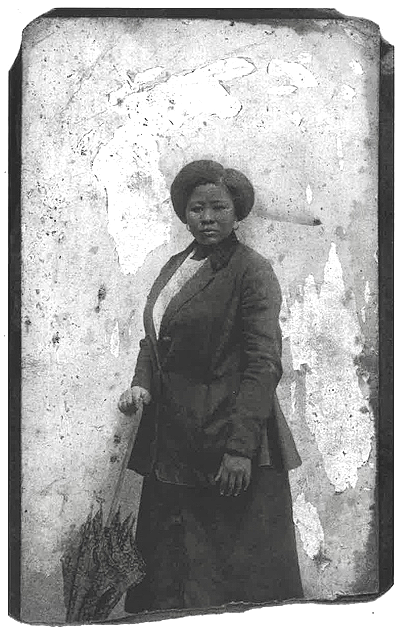
Unknown Potchefstroom Photographer, “Mmamothupi Motsoatsoe,” c.1910s. From Santu Mofokeng, The Black Photo Album / Look at Me: 1890-1950 (Göttingen: Steidl, 2013).
Rozetta Dubula and her friends, meanwhile, posed in bright, girlish “Sunday best” outfits: blouses, skirts, stockings, and straw hats. The women’s representation resists common assumptions about working-class Black South Africans during this period. In line with Mofokeng’s aversion to images that only portray Black struggle, this photograph contrasts the dehumanising depictions of manual labour without falling into the infantilising or sexualised stereotypes of ‘the native.’
Their arrangement echoes the conventions of a family portrait: one woman seated in the centre, the others standing to her side, hands resting on the chair. Yet these were working-class women, once again compelled to leave their families young due to the Natives’ Land Act. Mimi Sheller explains that for Africans on both sides of the Atlantic, ‘family sanctity and autonomy were crucial to popular ideas of freedom,’ and, thus, served as a symbol to underline their civility. Like Mmamothupi Motsoatsoe, these women use existing visual conventions to subvert the clichés surrounding them. By posing as kin and dressing in “pretty” and “respectable” clothing, they defy the erosion of kinship ties enacted by white policymakers, challenging the stereotypes associated with their Black working-class status.
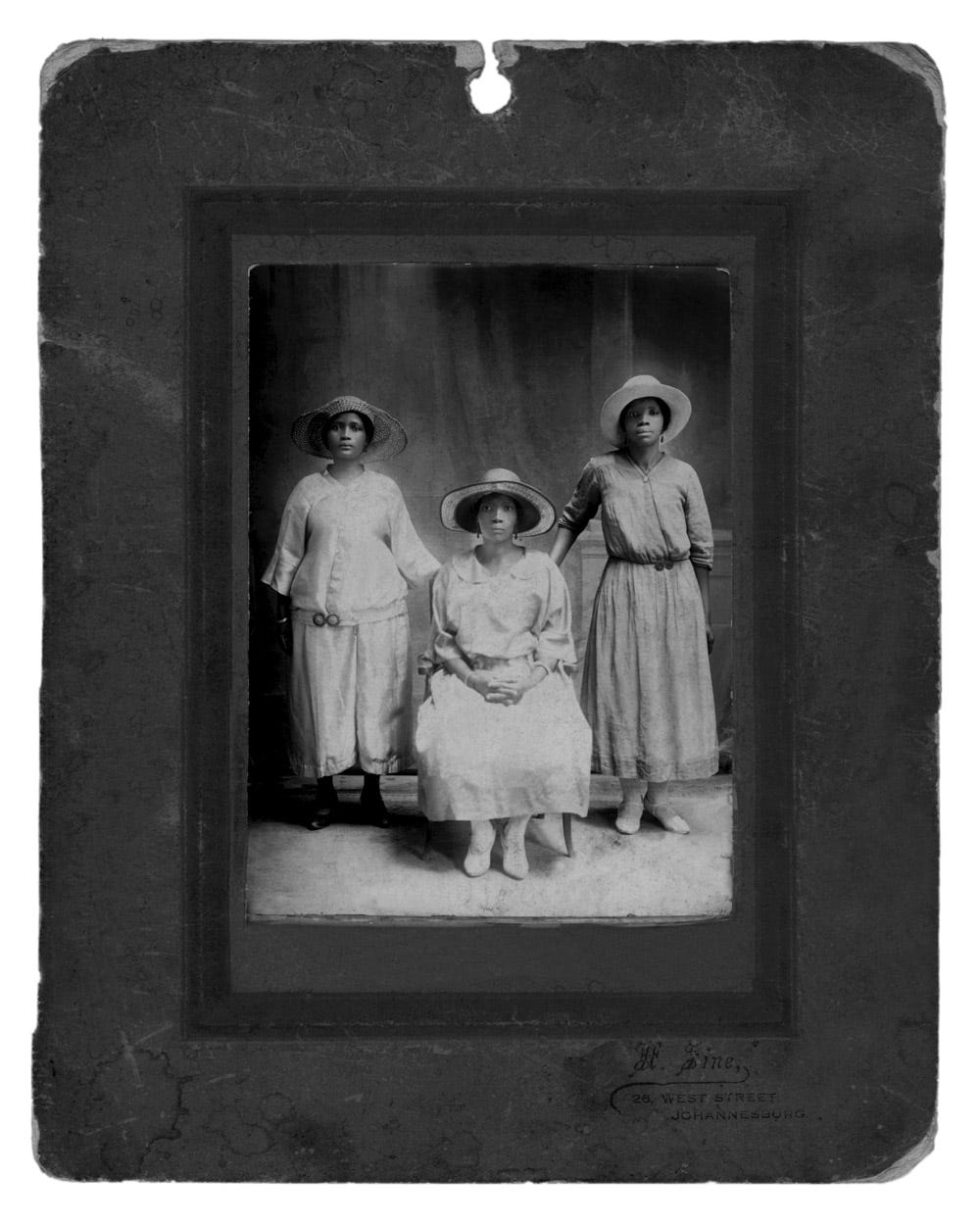
H.F. Fine Studio, 26 West Street, Johannesburg, ‘Rozetta Dubula and friends,’ c. 1910s. From Santu Mofokeng, The Black Photo Album / Look at Me: 1890-1950 (Göttingen: Steidl, 2013).
Demanding Recognition
The archive’s subtitle, ‘Look at Me’, recalls Sojourner Truth’s famous ‘And ain’t I a woman?’ speech, where she exclaimed: ‘And ain’t I a woman? Look at me! Look at my arm! I have ploughed and planted and gathered into barns, and no man could head me! And ain’t I a woman?’ In that speech, Truth demanded recognition as fully human, fully female, fully worthy of respect. Like Truth, these South African women weren’t trying to disappear into European norms. They were using those norms as tools to demand to be seen.
By borrowing visual and stylistic codes of middle-class European femininity, they challenged the stereotypes that their opressors often imposed, stereotypes of primitiveness, sexual promiscuity, or degradation. In their dress and, in turn, in their portraits, they asserted dignity, kinship, and social status.
Why It Matters Today
These photographs remind us that clothing is never trivial. It is deeply political. It can reinforce stereotypes, or it can subvert them. For women living under colonial rule, clothing often becomes a rare tool of resistance, a way to claim space, authority, and family bonds that the system tries to deny them.
Looking at these portraits today is to witness resilience in fabric and pose. A stiff collar, a parasol, a Sunday-best skirt, small details that became acts of defiance. In them, we see women refusing erasure, insisting on presence, and saying, still: Look at Me.
Written by Jasmine Niblett, 28.09.2025